
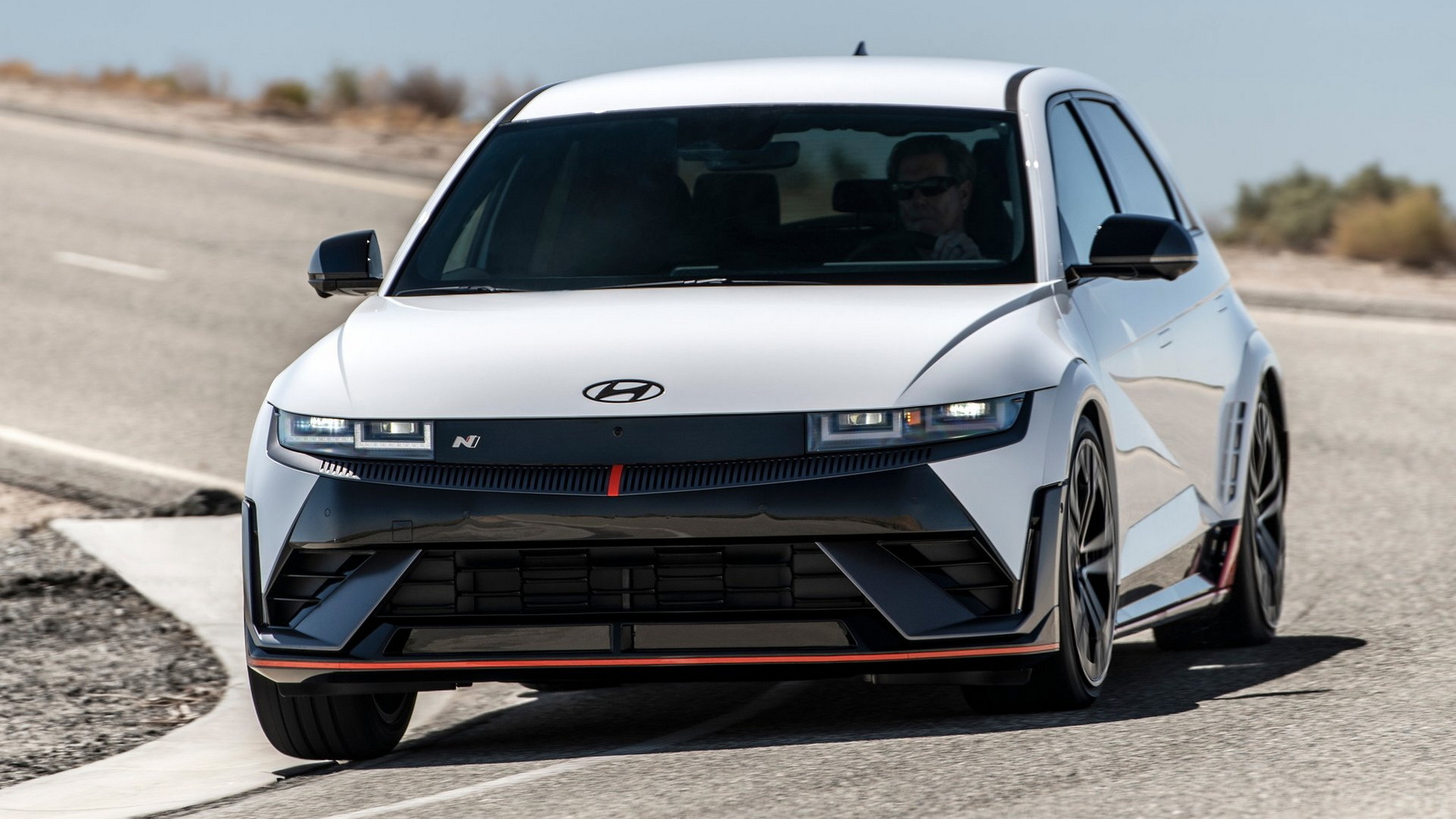
Ioniq 5 N salary sacrifice is the question that exposes how generously the UK tax system treats a fast electric car. This is a 650PS, £64,945-P11D performance machine, yet a higher-rate taxpayer pays roughly £87 a month in benefit-in-kind tax to run one through payroll. Our view: the maths is real and genuinely flattering, but a 478kW toy carries risks a sensible buyer should weigh before signing, and the gross-sacrifice saving is not the same thing as the tax bill.
What real owners say (CDE data)
CDE reviewed published UK owner and road-test commentary on the Ioniq 5 N across Carwow and What Car? alongside Hyundai UK specification data, checked 11 June 2026. We did not run a hands-on test of this car, so the signal below is owner-reported and journalist-reported, not a CDE inspection.
- Most-praised aspects: the simulated gearshift and N e-shift feel, genuine track ability for an EV, and the 84kWh battery returning rapid 10-80% charging in under 20 minutes on a suitable charger.
- Most-criticised aspects: real-world range falling well short of the headline once you drive it hard, tyre wear on a heavy performance EV, and insurance quotes that come in noticeably higher than a standard Ioniq 5.
- Reliability signal: Hyundai’s standard UK warranty runs five years with unlimited mileage and the high-voltage battery is covered for eight years or 100,000 miles; no Ioniq 5 N-specific safety recall is listed for the powertrain on the DVSA database at the time of writing.
Why a 650PS EV even belongs in a salary sacrifice scheme
Salary sacrifice lets you give up an agreed slice of gross pay in exchange for a fully insured, maintained electric car leased through your employer. Because the deduction comes out before income tax and National Insurance, you never pay tax on the sacrificed amount, which is where the saving comes from. The catch that makes a performance car interesting is what is, and is not, capped. There is no list-price cap on electric salary sacrifice cars in the way there is for some other benefits, so a £65,000 EV qualifies on the same tax footing as a £30,000 one. Individual employers can set their own internal price or monthly caps, and many do, but that is a scheme rule, not an HMRC rule. The Electric Car Scheme’s published guidance confirms the absence of a statutory cap. The one hard floor is the National Minimum Wage: a sacrifice cannot drop your gross pay below it, which on a £65k car is rarely the binding constraint for the senior earners these schemes target.

The car you are taxing: 478kW and 0-62 in 3.4 seconds
The figures matter because they explain both the appeal and the running-cost warnings. The Ioniq 5 N produces 478kW, which Hyundai quotes as 650PS, drawn from an 84kWh battery driving all four wheels, with 0-62mph dispatched in 3.4 seconds (Hyundai UK and Carwow specification data, June 2026). That puts it in genuine performance-saloon company on pace while wearing a hatchback body. UK pricing starts at around £65,800 on the road for the base car, with higher-spec versions nudging past £67,000 (Carwow listings, June 2026). For company-car tax the figure that counts is the P11D value, which Fleet News lists from £64,945. We use that P11D as the base for every calculation below, not the on-the-road price, because benefit-in-kind is charged on P11D.

How the benefit-in-kind tax is actually calculated
The formula is simple and worth seeing in full: P11D value, multiplied by the appropriate percentage for the car, multiplied by your marginal income-tax rate. For a fully electric, zero-emission car the appropriate percentage in the 2026/27 tax year is 4%, per HMRC’s published appropriate-percentage tables (checked 11 June 2026). On a £64,945 P11D that gives a taxable benefit of £2,597.80 for the year. You then pay your own income-tax rate on that benefit. A basic-rate taxpayer pays 20% of £2,597.80, a higher-rate taxpayer pays 40%, and an additional-rate taxpayer pays 45%. That benefit charge is the only part of the deal that HMRC treats as a taxable perk, and on an EV it is deliberately tiny.

The Ioniq 5 N salary sacrifice tax bill across all three bands
Here is the worked benefit-in-kind cost for 2026/27, calculated as £64,945 x 4% x your marginal rate. These are the BiK figures only, not the full monthly cost of the lease.
| Tax band | Annual taxable benefit | Annual BiK tax | Monthly BiK tax |
|---|---|---|---|
| Basic rate (20%) | £2,597.80 | £519.56 | about £43 |
| Higher rate (40%) | £2,597.80 | £1,039.12 | about £87 |
| Additional rate (45%) | £2,597.80 | £1,169.01 | about £97 |
Read that table carefully, because it is where most marketing goes quiet. Around £87 a month in tax to drive a 650PS car is the genuinely remarkable bit. It is also only a fraction of what leaves your payslip. Note too that the appropriate percentage is scheduled to rise to 5% in 2027/28 and step up further after that, so the benefit charge climbs a little each year over a typical lease, a point we expand on in our look at how to lock a four-year deal before BiK rises.

Gross sacrifice versus a personal lease: where the bigger saving hides
The number that actually moves your bank balance is the gross monthly sacrifice, the slice of pre-tax salary handed over for the car. Provider illustrations for the Ioniq 5 N cluster around £665 to £966 a month gross depending on term, mileage and what is bundled in, with net figures landing near £680 for a higher-rate taxpayer on one widely quoted Electric Car Scheme example. The saving against a personal lease comes because you never pay income tax or employee National Insurance on that gross amount. For a 40% taxpayer, every £100 of gross sacrifice costs roughly £58 of take-home pay once 40% tax and 2% NI relief are applied, so a headline £800 gross sacrifice feels closer to £465 net. Against an equivalent personal contract hire deal funded from taxed income, the effective saving on a car like this typically lands in the region of 30% to 40%. That is the real prize, and it dwarfs the £87 BiK line. The aggregators that shout “save up to 60%” are quoting a best-case gross-to-net gap for top earners with everything bundled, not the tax on the car. Treat the two as separate sums: a small, visible BiK charge, and a larger, quieter saving on the sacrifice itself. If you want to see the same mechanism on a mainstream car, our Tesla Model Y salary sacrifice breakdown runs the identical method on a cheaper P11D, and the salary sacrifice and the 60% tax trap piece shows why earners between £100,000 and £125,140 save most of all.

The honest risks of putting a performance EV through payroll
A low BiK figure makes the Ioniq 5 N look like free money, and that is exactly when buyers stop reading the small print. Three risks deserve attention. First, insurance: a 650PS car sits in high insurance groups, and while most schemes bundle cover, the premium is baked into your gross sacrifice, so a performance EV costs more per month than its P11D alone would suggest. Second, the benefit charge scales with P11D, so a £65k car already carries roughly twice the BiK of a £33k EV, and that gap widens as the appropriate percentage rises each year. Third, and most important, is leave-the-employer risk. Salary sacrifice cars are tied to your job. If you resign, are made redundant, or go on extended unpaid leave, the lease usually has to be settled or handed back, sometimes with early-termination costs. On a £800-a-month commitment that is a real liability, not a footnote. We cover the wider picture in our guide to salary sacrifice EV hidden costs.
Who the Ioniq 5 N salary sacrifice deal actually suits
This is a car for a settled higher or additional-rate taxpayer who genuinely wants the performance, has stable employment, and would otherwise be spending taxed income on something fast. For that buyer the combination of a sub-£100 BiK charge and a 30%-plus saving on the sacrifice is hard to argue with. It is a poor fit for anyone whose job feels uncertain, anyone tempted purely by the low tax line without budgeting for the gross sacrifice, or anyone who would be just as happy in a cheaper EV. The scheme you pick changes the sums too, so it is worth comparing funders, as we do in our Tusker, ElectriX and Octopus EV comparison, and weighing sacrifice against a cash allowance using our salary sacrifice versus car allowance analysis. If you want a calmer premium EV on the same tax logic, the BMW i5 salary sacrifice maths makes a useful counterpoint.
Our take
Our view on Ioniq 5 N salary sacrifice: the tax case is unusually strong, but only for the right buyer. A 650PS performance EV that costs a higher-rate taxpayer roughly £87 a month in benefit-in-kind, and saves 30% or more against a personal lease on the gross sacrifice, is one of the clearest demonstrations of how the EV company-car rules work in 2026/27. We would do it, with two conditions. Be honest that the gross sacrifice, not the headline BiK, is what you are committing to, and that on this car it is a meaningful monthly figure. And be sure your job is stable enough to carry a lease tied to your employment, because the leave-the-employer exit is where these deals bite. Score this purely as a tax play and it is excellent; score it as a sensible use of money and it depends entirely on whether you actually want, and can comfortably carry, a fast car. Our score: 8/10.
What to check before you sign a scheme agreement
- Confirm the current 0 g/km appropriate percentage on the HMRC appropriate-percentage page for the tax year your lease starts, and for each later year it runs.
- Read the scheme’s early-exit terms in full, especially what happens if you leave your employer, and whether early-termination protection is included.
- Check exactly what the gross sacrifice bundles: maintenance, tyres, insurance and a home charger are not always all included.
- Ask whether your employer applies an internal price or monthly cap, since there is no statutory list-price cap but scheme caps are common.
- Use the government-backed guidance at MoneyHelper to sanity-check insurance assumptions, and confirm the P11D and powertrain figures on Fleet News before you rely on a provider quote.
How much is benefit-in-kind on a Hyundai Ioniq 5 N in 2026/27?
On a £64,945 P11D at the 4% electric-car appropriate percentage for 2026/27, the taxable benefit is £2,597.80 a year. A basic-rate taxpayer pays about £43 a month, a higher-rate taxpayer about £87 a month, and an additional-rate taxpayer about £97 a month. The rate rises to 5% in 2027/28, so the charge increases slightly each year of a lease.
Is there a list-price cap on electric salary sacrifice cars?
No. There is no statutory list-price cap that stops a £65,000 EV qualifying for salary sacrifice, which is why a performance car like the Ioniq 5 N works on the same tax footing as a cheap one. Individual employers can set their own internal price or monthly caps as a scheme rule, so check what your provider and employer allow before assuming a high-value car is available.
What is the real saving versus a personal lease?
The big saving comes from the gross sacrifice, not the benefit-in-kind line. Because the sacrificed salary avoids income tax and employee National Insurance, a 40% taxpayer effectively pays around 58p of take-home pay for every £1 of gross sacrifice. Against an equivalent personal contract hire funded from taxed income, the effective saving on a car like this typically lands around 30% to 40%, depending on your tax band and what the lease bundles.
What happens to the car if I leave my job?
Salary sacrifice cars are tied to your employment. If you resign, are made redundant, or take extended unpaid leave, the lease normally has to be settled or the car handed back, sometimes with early-termination costs. Some schemes include early-exit protection. On a high-value performance EV with a large monthly sacrifice this is the single most important term to read before signing.
Does salary sacrifice cover insurance on a 650PS car?
Most schemes bundle fully comprehensive insurance, maintenance, tyres and breakdown cover into the monthly sacrifice, but not all do, and a 650PS car sits in high insurance groups, so the cost is real even when hidden inside the gross figure. Confirm exactly what is included, and check whether a home charger is part of the package or a separate cost.
Is the Ioniq 5 N a sensible salary sacrifice choice?
As a pure tax exercise it is excellent, with a small benefit charge and a strong saving on the sacrifice. As a money decision it depends on you. It suits a settled higher or additional-rate taxpayer who genuinely wants the performance and can carry the gross sacrifice and the leave-the-employer risk. If you only want the low tax line, a cheaper EV gives most of the same advantage for less commitment.
Buyer action
EV and salary-sacrifice checks
Use this as the final check before paying a deposit, signing finance paperwork or relying on a headline monthly figure.