UPDATED · News · 25 May 2026 · Michael Harrison
DVSA Tightens ADAS Rules: What UK Drivers Should Know UK 2026.
UK and European regulators have spent the last three years tightening the screws on Advanced Driver Assistance Systems, the suite of camera, radar and software-based safety features that have quietly become standard on the median new car sold in Britain. The most consequential rule, the UNECE General Safety Regulation (GSR2) covering automatic emergency braking and adopted into UK type approval via the DVSA and VCA, is already in force for new model approvals and reshaping what manufacturers ship on UK forecourts today.
CDE has looked at the actual regulations, manufacturer submissions, Euro NCAP and Thatcham Research testing data, and what is changing in UK showrooms right now. The short version: AEB is being held to a much higher standard, drivers should understand what their car can and cannot do, and the patchy real-world performance that plagued early systems is finally being addressed.
What the new rules actually require
Under post-Brexit UK type approval, administered by the VCA and enforced by the DVSA, all newly type-approved passenger cars and light commercial vehicles must come with automatic emergency braking as standard, with the requirement extending to every new vehicle registered from July 2026. The system must detect and react to pedestrians at speeds up to 60 km/h (around 37 mph) in daylight and at lower speeds at night, and must be able to bring the vehicle to a complete stop from up to 100 km/h (around 62 mph) before striking a lead vehicle.
These numbers represent a sharp upgrade from what most current AEB systems actually achieve. The 2022 to 2024 rounds of Euro NCAP and Thatcham Research pedestrian AEB testing found wide variation among manufacturers, with several supposedly-equipped vehicles failing to detect adult pedestrians at standard test speeds, and almost universal poor performance in nighttime tests. The tightened UNECE regulations are the regulatory response to that data.
How we got here: AEB has been promised for a decade
AEB has technically been available on UK new cars since the late 2000s. From 2014 onwards, Euro NCAP began awarding additional points for AEB fitment, and most volume manufacturers committed to standardising the feature across their UK ranges by 2022, a target largely met but with significant variation in actual system quality. The UNECE GSR2 rules, adopted by the UK through type approval, replace that informal pressure with a performance-based mandate that holds every system to the same testing standard regardless of brand.
Manufacturer reaction has been mixed. Major brands including Toyota, Honda, Ford and Vauxhall have all stated they can meet the new standard with software updates and modest hardware revisions to existing systems. A coalition of OEMs lobbied through the SMMT for clarifications and a softer phase-in, citing what they describe as test conditions that exceed what current radar and camera hardware can reliably handle. The DVSA and DfT granted some technical clarifications but kept the headline requirements intact.
Why Euro NCAP data matters more than the regulation for buyers right now
The regulatory floor catches up over the next couple of years, but for buyers shopping today the better signal is the Euro NCAP and Thatcham Research scoring on Safety Assist and Vulnerable Road User protection. Cars rated five stars in the 2024 to 2026 Euro NCAP cycle, with strong Safety Assist sub-scores, generally meet or exceed what the tightened UNECE rules require. Cars scoring poorly on Safety Assist generally do not.

The Euro NCAP database is free to search at euroncap.com and lets you filter by make, model and year. CDE strongly recommends UK buyers add the Safety Assist sub-score to their pre-purchase checklist alongside the overall star rating. The two are correlated but not identical; a car can score five stars overall while still being merely average on AEB and lane-keeping performance. What Car? and Auto Express also publish year-on-year safety roundups that flag the gap.
Where current systems still fall short
Three known limitations on current AEB systems should shape how you think about their real-world capability. One: night performance is sharply worse than daylight performance on most systems. Euro NCAP’s nighttime pedestrian testing has been a regulatory pressure point precisely because the gap is so wide. If you do a lot of night driving on unlit rural A-roads, do not assume the system will catch a pedestrian or cyclist that you miss.
Two: cross-traffic detection (a car or pedestrian moving perpendicular to your path) is unreliable on most non-premium systems. The system is much better at detecting an object directly in front of you than at predicting the path of an object approaching from the side. Mini-roundabouts and urban junctions remain a known weak point.
Three: rear cross-traffic AEB (the system that brakes for cross-traffic behind you when reversing) is a separate feature that is not standardised and not yet covered by the new UK type approval rules. If your car has rear cross-traffic alert (camera or radar warning) without rear cross-traffic AEB (which actually applies the brakes), the system will tell you about a problem but will not act on it. Worth knowing before you reverse off a busy driveway.

What about lane keeping, adaptive cruise and hands-free driving?
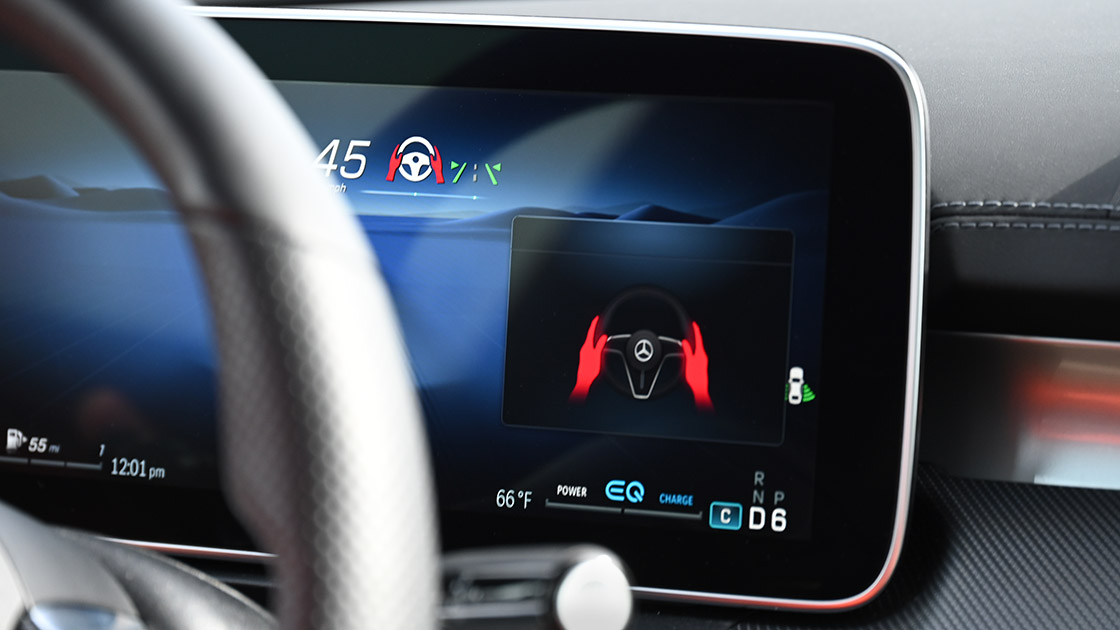
The tightened UNECE rules cover automatic emergency braking and a defined set of mandated assists (Intelligent Speed Assistance, lane-keeping, driver drowsiness detection). The broader category of optional ADAS features (adaptive cruise control, blind spot monitoring and hands-free motorway driving systems such as Ford BlueCruise, BMW Highway Assistant and Mercedes Drive Pilot) sits outside the AEB mandate and remains a manufacturer choice.
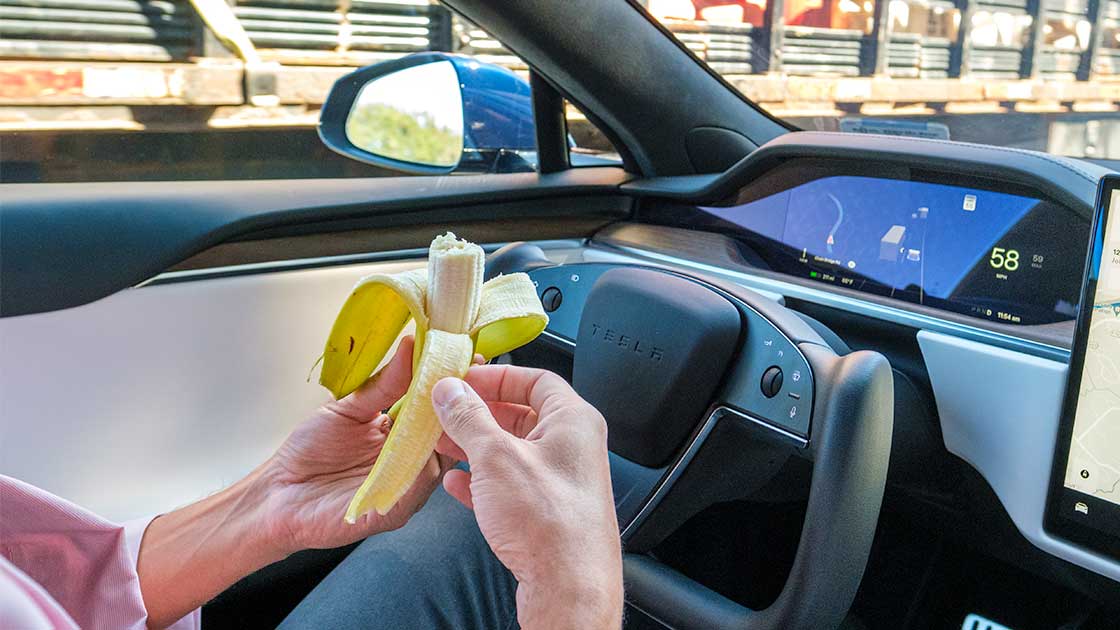
The DVSA and DfT have opened separate workstreams on hands-free systems, with Ford BlueCruise the first hands-off system formally authorised for motorway use in Great Britain. Tesla’s Autopilot and so-called Full Self-Driving (Supervised) remain Level 2 in the UK, and Tesla has been the subject of multiple international investigations into crashes in conditions where the system should have been disengaged but the driver remained reliant on it.
Buyers should treat any Level 2 ADAS feature (including Tesla’s Full Self-Driving Supervised) as a driver-assistance tool, not a self-driving feature. The driver remains legally responsible for the vehicle at all times when these systems are engaged. The Society of Automotive Engineers (SAE) Level 3 conditional automation is starting to appear in limited deployments , Mercedes Drive Pilot is type-approved in parts of Europe and the Automated Vehicles Act 2024 sets the UK framework for self-driving authorisations , but the wider fleet remains firmly Level 2.
What this means for UK car buying right now
Three concrete takeaways. One: when shopping, check the Euro NCAP Safety Assist sub-score in addition to the overall star rating. Cars scoring strongly on Safety Assist in the current Euro NCAP cycle (2024 and 2025 model years) are functionally meeting the tightened UK type approval standard. Cars scoring poorly may need future updates that some manufacturers will provide and others will not.
Two: do not pay extra on PCP or PCH monthlies for a premium driver-assist pack on the assumption it reduces your responsibility. It does not. These are convenience features that may reduce certain types of crash risk; they do not reduce your obligation to drive attentively, and they will not meaningfully shift your insurance group or premium with most UK insurers.
Three: if you are running a 2018-and-earlier car without standard AEB, the safety upgrade you get from the next car you buy will be larger than any other equipment change you can make. The pedestrian-detection AEB on a 2024-and-later car is real, demonstrably reduces certain crash types per Euro NCAP and Thatcham Research data, and represents the most significant safety advance for everyday driving in the last 20 years , well worth factoring in alongside MOT history and VED band when comparing a used buy against a fresh PCP deal.
Buyer action
Where to check next
Use this as the final check before paying a deposit, signing finance paperwork or relying on a headline monthly figure.