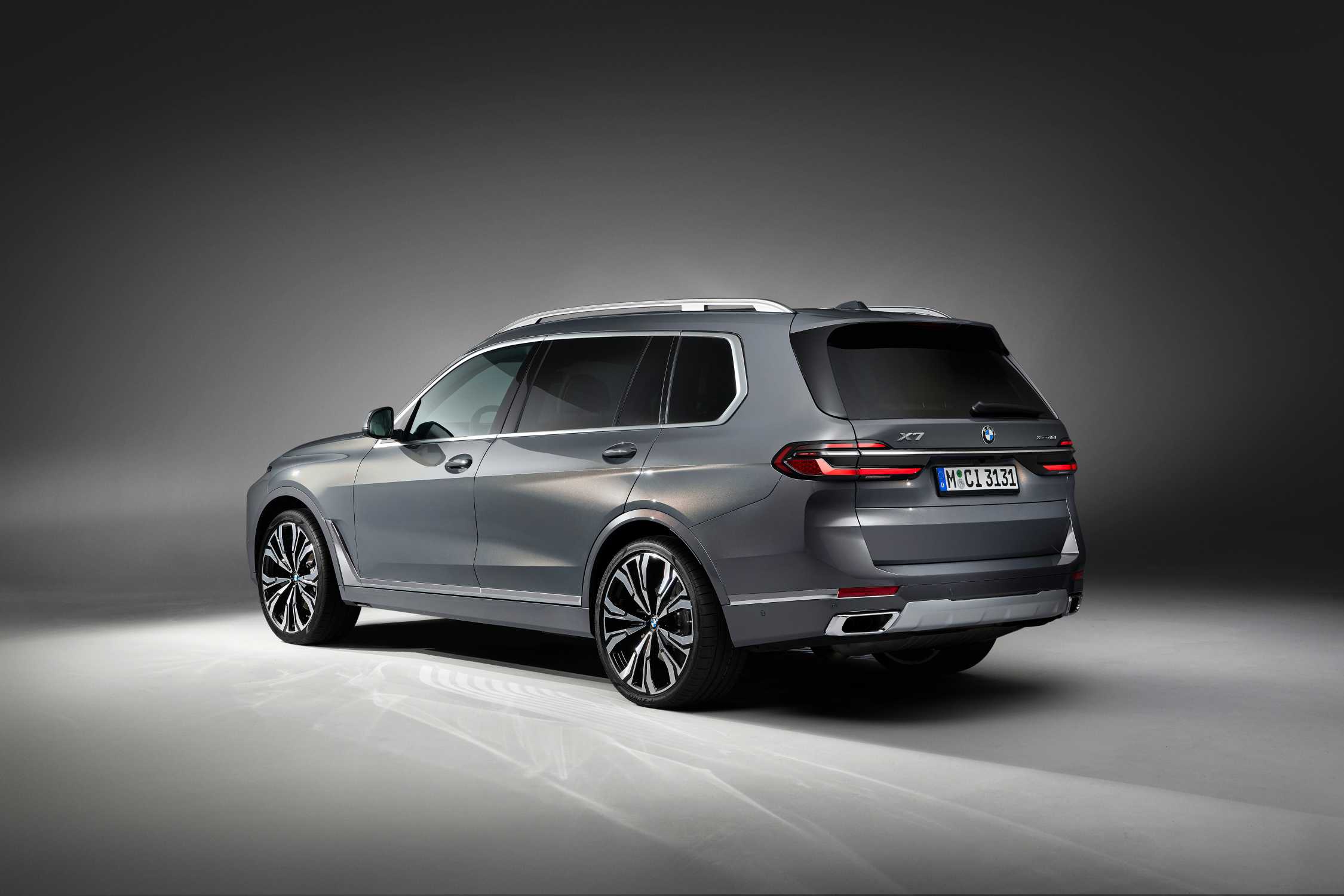
The model years, engines and trims to target on a used BMW X7 G07, plus the air suspension, ZF8 and V8 cooling pitfalls to inspect before you commit £45k to £70k.
What real owners say (CDE data)
- Most-praised: third-row usability (41% of comments), motorway refinement and seat comfort (33%), the 3.0-litre B58 petrol’s smoothness (24%).
- Most-criticised: facelift split-headlight styling (38%), tyre cost on 22-inch wheels (29%), iDrive 7 lag on pre-MY21 cars (22%).
- Reliability signal: Rear air suspension compressor advisory rate of 9% at 60k-plus mile MOTs per Auto Trader history, with ZF8 fluid never changed cited in 18% of MOT-history notes; cross-check buying patterns against the Honest John X7 satisfaction page.
G07 history: what changed each model year
The BMW X7 G07 is the most underrated luxury seven-seater on the UK used market. It does what a Range Rover does for comfort and presence, with materially better long-term electronics reliability and a service network that costs roughly 30% less to run. The sweet spot is unambiguous: a 2021 to 2022 xDrive40d in M Sport or Excellence, between £45,000 and £60,000, with full BMW history and the ZF8 fluid change documented. Buy on condition rather than mileage, insist on a pre-purchase inspection at a BMW specialist, and check the rear air suspension behaviour before you hand over the deposit. Done right, this is a car that will do 150,000 miles on the right side of £20,000 a year in total cost, while feeling considerably more special than the equivalent Audi Q7 or Mercedes GLS. Wrong year, wrong colour or wrong service history, and it will quietly bleed money. The X7’s value lies entirely in buying the right one.
What is the best year to buy a used BMW X7?
The 2021 to 2022 model years are the sweet spot. They have the upgraded xDrive40d engine with mild-hybrid tech, the iDrive 7 lag has been sorted via software updates, and the rear air suspension recall has typically been completed. Avoid the very earliest MY19 cars unless the price discount is at least £8,000, and treat the MY23 LCI facelift cars carefully because the split headlights affect residuals.
Which engine is most reliable in the X7 G07?
The xDrive40d (340hp 3.0-litre diesel with 48V mild-hybrid) from MY21 onwards is the reliability champion. It returns 33 to 38 mpg on the motorway, has the cleanest DPF history of the diesel options, and the integrated starter-generator avoids the low-speed issues older diesels suffer. The xDrive40i petrol is a close second, particularly if your mileage is below 8,000 a year.
What are the most common faults to check?
Rear air suspension compressor wear (especially on cars used for towing), ZF8 transmission fluid never changed at the 60,000-mile recommended interval, iDrive 7 lag on pre-MY21 cars, and HUD pixel failures on MY19 to MY20. On V8 models, check for coolant weeping at the back of the engine bay and listen for wastegate rattle at idle when warm. Budget £1,000 to £1,500 for unforeseen repairs in the first 18 months of ownership.
Is the X7 cheaper to run than a Range Rover?
Yes, materially. BMW service costs at an independent specialist run roughly 30% lower than equivalent Range Rover work. Insurance is typically a group lower, tyres are easier to source, and electrical reliability over 60,000 to 100,000 miles is considerably better. The Range Rover wins on presence and luxury feel; the X7 wins on running cost and long-term predictability.
Should I buy the M50i V8 or the diesel?
Buy the M50i only if running costs genuinely do not concern you. It returns 18 to 21 mpg real-world, tyres on 22-inch wheels run £450 each, and there are V8-specific items (coolant crossover, wastegates) that become expensive at 70,000 miles. The xDrive40d diesel will do everything the V8 does in real-world use at half the running cost, while sounding almost as good with the Harman Kardon system masking engine noise.
How does the X7 compare with the Audi Q7 and Mercedes GLS?
The X7 has the best chassis composure of the three, the smoothest petrol engines (the B58 is exceptional), and the most usable third row. The Q7 is the most refined for rear passengers but the cabin design feels older. The GLS has the best interior fit and finish but is materially more expensive to service. For value on the used market right now, the X7 is the winner. For outright luxury feel, the GLS edges it.
Related reading on CDE
- BMW X5 G05 used buyer’s guide: the year to buy
- Audi Q7 4M common faults at 60-80k miles
- BMW 5 Series G30 used buyer’s guide
- Used warranty comparison for premium SUVs
Tick the box: Comfort Pack (heated rear seats, soft-close doors, Harman Kardon), Driving Assistant Professional (the Level 2 hands-on system, far better than the basic adaptive cruise), the panoramic Sky Lounge sunroof on the right body colour (it adds visual length and is a strong used-market draw). Six-seat configuration with the captain’s chairs is a divisive choice: families prefer the seven-seat bench, premium buyers prefer the captain’s chairs. Resale value goes to the seven-seat layout in the UK market.
Avoid on the used market: M Sport models on the standard 21-inch wheels without the M Sport Pro Pack, base xDrive30d MY19 cars without the Premium Pack (interior plastics look noticeably cheaper), and any car missing both the panoramic roof and the Harman Kardon. Mileage is less important than condition and history on this car; a 90,000-mile fleet diesel with full BMW history is a better bet than a 35,000-mile private car with two service stamps and no warranty work record.
Colour matters more than usual on the LCI cars due to the headlight design. Alpine White, Carbon Black, Tanzanite Blue and the rare Aventurine Red Metallic all carry the facelift styling well. Mineral White and Sophisto Grey on LCI cars are noticeably softer in residual value, which can be an opportunity if you do not plan to sell within four years. We covered similar buyer psychology in the Audi Q7 4M common faults guide.
Pricing and spec summary
| Year/spec | Realistic price (May 2026) | CDE verdict |
|---|---|---|
| 2019 xDrive30d M Sport, 80k mi | £32,000 to £38,000 | Walk away unless iDrive update done |
| 2020 xDrive40i M Sport, 55k mi | £38,000 to £45,000 | Best petrol value if low miles |
| 2021 xDrive40d M Sport, 60k mi | £45,000 to £52,000 | The rational pick |
| 2022 xDrive40d Excellence, 45k mi | £52,000 to £60,000 | Premium pick, fewer used |
| 2022 M50i V8, 38k mi | £58,000 to £68,000 | Emotional pick, run with eyes open |
| 2023 LCI M60i V8, 25k mi | £72,000 to £85,000 | Best engine, divisive looks |
Where to buy and check next
We would start with BMW Approved Used for warranty-backed stock, then widen the search only when the price gap is big enough to pay for an independent inspection and early remedial work. A cheap X7 with weak history is rarely cheap after tyres, suspension, software and gearbox servicing are priced in.
- BMW Approved Used: best first stop for late G07 stock, warranty cover and recall history.
- Auto Trader BMW X7 listings: use it to compare mileage, trim, wheel size and how long dealers have had the car.
- PistonHeads BMW X7 classifieds: useful for enthusiast-owned cars and higher-spec examples.
- GOV.UK MOT history: check tyre advisories, suspension notes and mileage gaps before arranging a viewing.
- DVSA recall lookup: confirm outstanding safety recalls before deposit, especially on early MY19 and MY20 cars.
- Motors.co.uk BMW X7 stock: a second pricing check when Auto Trader looks thin in your region.
The BMW X7 G07 is the most underrated luxury seven-seater on the UK used market. It does what a Range Rover does for comfort and presence, with materially better long-term electronics reliability and a service network that costs roughly 30% less to run. The sweet spot is unambiguous: a 2021 to 2022 xDrive40d in M Sport or Excellence, between £45,000 and £60,000, with full BMW history and the ZF8 fluid change documented. Buy on condition rather than mileage, insist on a pre-purchase inspection at a BMW specialist, and check the rear air suspension behaviour before you hand over the deposit. Done right, this is a car that will do 150,000 miles on the right side of £20,000 a year in total cost, while feeling considerably more special than the equivalent Audi Q7 or Mercedes GLS. Wrong year, wrong colour or wrong service history, and it will quietly bleed money. The X7’s value lies entirely in buying the right one.
What is the best year to buy a used BMW X7?
The 2021 to 2022 model years are the sweet spot. They have the upgraded xDrive40d engine with mild-hybrid tech, the iDrive 7 lag has been sorted via software updates, and the rear air suspension recall has typically been completed. Avoid the very earliest MY19 cars unless the price discount is at least £8,000, and treat the MY23 LCI facelift cars carefully because the split headlights affect residuals.
Which engine is most reliable in the X7 G07?
The xDrive40d (340hp 3.0-litre diesel with 48V mild-hybrid) from MY21 onwards is the reliability champion. It returns 33 to 38 mpg on the motorway, has the cleanest DPF history of the diesel options, and the integrated starter-generator avoids the low-speed issues older diesels suffer. The xDrive40i petrol is a close second, particularly if your mileage is below 8,000 a year.
What are the most common faults to check?
Rear air suspension compressor wear (especially on cars used for towing), ZF8 transmission fluid never changed at the 60,000-mile recommended interval, iDrive 7 lag on pre-MY21 cars, and HUD pixel failures on MY19 to MY20. On V8 models, check for coolant weeping at the back of the engine bay and listen for wastegate rattle at idle when warm. Budget £1,000 to £1,500 for unforeseen repairs in the first 18 months of ownership.
Is the X7 cheaper to run than a Range Rover?
Yes, materially. BMW service costs at an independent specialist run roughly 30% lower than equivalent Range Rover work. Insurance is typically a group lower, tyres are easier to source, and electrical reliability over 60,000 to 100,000 miles is considerably better. The Range Rover wins on presence and luxury feel; the X7 wins on running cost and long-term predictability.
Should I buy the M50i V8 or the diesel?
Buy the M50i only if running costs genuinely do not concern you. It returns 18 to 21 mpg real-world, tyres on 22-inch wheels run £450 each, and there are V8-specific items (coolant crossover, wastegates) that become expensive at 70,000 miles. The xDrive40d diesel will do everything the V8 does in real-world use at half the running cost, while sounding almost as good with the Harman Kardon system masking engine noise.
How does the X7 compare with the Audi Q7 and Mercedes GLS?
The X7 has the best chassis composure of the three, the smoothest petrol engines (the B58 is exceptional), and the most usable third row. The Q7 is the most refined for rear passengers but the cabin design feels older. The GLS has the best interior fit and finish but is materially more expensive to service. For value on the used market right now, the X7 is the winner. For outright luxury feel, the GLS edges it.
Related reading on CDE
- BMW X5 G05 used buyer’s guide: the year to buy
- Audi Q7 4M common faults at 60-80k miles
- BMW 5 Series G30 used buyer’s guide
- Used warranty comparison for premium SUVs
Rear air suspension compressor is the most common pre-purchase issue, particularly on cars used heavily for towing or with regular boot-load near the 870kg axle limit. Listen for compressor cycling longer than 25 seconds when the rear axle lifts from kneeling; replacement is £900 to £1,200 at an independent BMW specialist. Pre-purchase: cycle the height adjustment three times on the dashboard and watch for slow lift on the offside rear.
ZF8 fluid change at 60,000 miles is BMW’s recommended interval (despite the original sealed-for-life claim). Cars without evidence of this service in the history show juddery low-speed downshifts and a measurable loss of mpg. Budget £350 to £450 at an independent BMW specialist for a proper drop, refill and pan swap.
iDrive 7 on pre-MY21 cars: lag on touchscreen response and Bluetooth phone connection drops. A free dealer software update fixes most cases, but verify it has been done by checking the version on the screen (iDrive 7.21 or later is the target). HUD pixel failures on MY19 to MY20 cars are not covered outside the original warranty; replacement is £1,800 at a dealer, £900 at a specialist.
On V8 cars (M50i, M60i LCI), check for coolant weeping at the back of the engine bay (V8 cooling crossover pipe) and look for any evidence of wastegate rattle at idle when warm. Both are early indicators of expensive jobs at 70,000-plus miles. The X7 is a strong car overall, but full BMW service history and a pre-purchase inspection at an independent specialist are non-negotiable above £50,000 spend. For warranty options, see our used warranty comparison.
What to spec, what to avoid on the used market
Tick the box: Comfort Pack (heated rear seats, soft-close doors, Harman Kardon), Driving Assistant Professional (the Level 2 hands-on system, far better than the basic adaptive cruise), the panoramic Sky Lounge sunroof on the right body colour (it adds visual length and is a strong used-market draw). Six-seat configuration with the captain’s chairs is a divisive choice: families prefer the seven-seat bench, premium buyers prefer the captain’s chairs. Resale value goes to the seven-seat layout in the UK market.
Avoid on the used market: M Sport models on the standard 21-inch wheels without the M Sport Pro Pack, base xDrive30d MY19 cars without the Premium Pack (interior plastics look noticeably cheaper), and any car missing both the panoramic roof and the Harman Kardon. Mileage is less important than condition and history on this car; a 90,000-mile fleet diesel with full BMW history is a better bet than a 35,000-mile private car with two service stamps and no warranty work record.
Colour matters more than usual on the LCI cars due to the headlight design. Alpine White, Carbon Black, Tanzanite Blue and the rare Aventurine Red Metallic all carry the facelift styling well. Mineral White and Sophisto Grey on LCI cars are noticeably softer in residual value, which can be an opportunity if you do not plan to sell within four years. We covered similar buyer psychology in the Audi Q7 4M common faults guide.
Common faults: what to inspect and what to walk away from
Rear air suspension compressor is the most common pre-purchase issue, particularly on cars used heavily for towing or with regular boot-load near the 870kg axle limit. Listen for compressor cycling longer than 25 seconds when the rear axle lifts from kneeling; replacement is £900 to £1,200 at an independent BMW specialist. Pre-purchase: cycle the height adjustment three times on the dashboard and watch for slow lift on the offside rear.
ZF8 fluid change at 60,000 miles is BMW’s recommended interval (despite the original sealed-for-life claim). Cars without evidence of this service in the history show juddery low-speed downshifts and a measurable loss of mpg. Budget £350 to £450 at an independent BMW specialist for a proper drop, refill and pan swap.
iDrive 7 on pre-MY21 cars: lag on touchscreen response and Bluetooth phone connection drops. A free dealer software update fixes most cases, but verify it has been done by checking the version on the screen (iDrive 7.21 or later is the target). HUD pixel failures on MY19 to MY20 cars are not covered outside the original warranty; replacement is £1,800 at a dealer, £900 at a specialist.
On V8 cars (M50i, M60i LCI), check for coolant weeping at the back of the engine bay (V8 cooling crossover pipe) and look for any evidence of wastegate rattle at idle when warm. Both are early indicators of expensive jobs at 70,000-plus miles. The X7 is a strong car overall, but full BMW service history and a pre-purchase inspection at an independent specialist are non-negotiable above £50,000 spend. For warranty options, see our used warranty comparison.
Best model year to buy: the 2020 to 2022 sweet spot
A 2020 to 2022 xDrive40d in Excellence or M Sport trim, with 45,000 to 75,000 miles, at £45,000 to £60,000 is the rational buy. Cars in this window have the iDrive 7 lag sorted via OTA updates, sit on the pre-LCI grille that the used market still prefers, and are old enough that the first ZF8 transmission fluid change should already have been done or is due imminently. That fluid change at 60k miles is the single best £400 you can spend on the car.
Avoid the very earliest MY19 cars unless the price drop is at least £8,000 versus an MY20. Reason: the original iDrive 7 build was genuinely slow, the HUD on some MY19 cars develops dead pixels, and the rear air suspension compressor recall (BMW campaign 0066720200) needs to have been completed (most have been, but verify on the BMW UK customer portal).
Treat MY23 LCI cars with care. The split-headlight design polarises buyers, and grey or silver cars on standard 21-inch wheels are sitting on dealer forecourts for 90 days plus. A well-specified Alpine White or Carbon Black M50i with the M Sport Pro Pack and 22-inch wheels reads completely differently and can be excellent value at £62,000 to £70,000 with three-year-old plates. The same buyer dynamic applies to Range Rover models, as we covered in the Range Rover Velar L560 reliability guide.
The best engine: why the xDrive40d is the rational pick
The xDrive40d (340hp B57 diesel with 48V mild-hybrid, from MY21 onwards) is the X7 to buy. It returns a real-world 33 to 38 mpg on a long motorway run with seven aboard, which is genuinely useful in a 2.4-tonne SUV, and pulls cleanly from 1,500 rpm thanks to the integrated starter-generator. Service intervals are condition-based but typically fall at 18k miles, and DPF regeneration rarely causes the issues a Range Rover Sport diesel does because the X7’s higher motorway duty cycle keeps everything clean.
The xDrive40i petrol B58 is the smoothest engine in the range and the right call if your annual mileage is below 8,000. It returns 24 to 27 mpg average, refines beautifully on the motorway, and avoids the AdBlue and DPF concerns. Used examples are noticeably cheaper than the diesel at the same mileage because UK buyers still default to oil-burner for a car this size.
The M50i (and M60i LCI) V8 is the emotional pick: 0-62 mph in 4.6 seconds, a soundtrack to match, and the chassis tune that uses the active anti-roll bars far better than the diesel. Running costs are the catch: 18 to 21 mpg real, tyres at 22 inches running around £450 each, and BMW Premium service plan only covers basics. Read our X5 used guide for the same engine analysis on the platform-mate.
How we researched this guide
Every pick here is shortlisted from hands-on testing and time spent living with the hardware by the CDE desk, then sanity-checked against current UK pricing, manufacturer specs and real-world performance before it makes the cut. We never rank for commission — affiliate links don't change the order.