UK public charging prices have settled into a pattern that rewards the drivers who read the small print and punishes everyone else, and Zapmap’s May 2026 price index lays it bare: a weighted average of 54p per kWh on slower chargers and 79p per kWh on rapid and ultra-rapid units. Within that average sits a spread from about 62p to 92p on the big rapid networks, which is the difference between a sensible top-up and a fleecing. I run the numbers below, name the cheapest and dearest networks, and tell you where I would actually plug in.
UK public charging prices in 2026: the key facts
- Average rapid price: about 79p per kWh PAYG in May 2026 (Zapmap).
- Cheapest rapid network: Tesla Supercharger, open to all at roughly 62p per kWh.
- Dearest rapid networks: InstaVolt and BP Pulse, around 89p to 92p PAYG.
- Home off-peak: roughly 7p to 8p per kWh on a smart EV tariff, a tenth of public rapid.
- The lever: memberships and roaming apps cut the headline PAYG price.
What public charging prices actually look like now
Start with the number that frames everything else. Charge at home on a smart EV tariff and you are paying somewhere around 7p to 8p per kWh off-peak. Charge on a public rapid and the weighted average is 79p per kWh (Zapmap’s price index, May 2026). That is not a small premium, it is roughly ten times the cost, and it is the single most important fact in EV running costs. Anyone who can charge at home and chooses to live on the rapid network is throwing money away, which is exactly the mindset I bring to the Advisory Electricity Rate for business mileage: know what you are actually paying before you accept a flat figure.
On the public network the spread is wide enough to matter. Pay-as-you-go on the major rapid networks runs from about 62p per kWh at Tesla’s open Superchargers to roughly 89p to 92p at BP Pulse and InstaVolt, with Gridserve’s Electric Forecourts and Ionity’s hubs sitting in the high-70s to low-90s depending on site, as Auto Express’s network round-up tracks. On a 60kWh top-up, the gap between the cheapest and dearest of those is around £18 for the same electricity. That is the kind of difference that does not show up on the dashboard but absolutely shows up on the monthly statement, and it is why I treat charging like any other running cost worth shopping, the same way I would a company-car tax band.
The cheapest networks, and the ones to avoid on PAYG
If you are paying as you go, Tesla’s open Supercharger network is the one to seek out. At around 62p per kWh it undercuts almost everyone, the reliability is excellent, and non-Tesla drivers can now use most sites through the Tesla app. At the other end, InstaVolt and BP Pulse are the networks I would only use on PAYG in an emergency: at roughly 89p to 92p per kWh you are paying a premium that the reliability, good as it is, does not justify when cheaper electrons are usually nearby. Gridserve and Ionity sit in between, dearer on PAYG but often part of roaming deals that bring the price down.
That word, roaming, is where the savings hide. A single app such as Octopus Electroverse lets you charge across dozens of networks on one account, often at a better rate than walking up and tapping a card, and BP Pulse’s own subscription drops its price meaningfully for members. The lesson is consistent: the advertised PAYG figure is the price for the unprepared. Spend ten minutes setting up a roaming account and a network subscription or two, and you stop paying the tourist rate.
Home charging is the real saving
I will keep saying it because it is the part that changes the maths entirely: the cheapest charging is the one nobody advertises, your own driveway on an off-peak tariff. At 7p to 8p per kWh, a full charge on a 60kWh car costs about £4 to £5, against £45 to £55 for the same electricity on a 90p rapid. Over a year of average mileage that gap is well into four figures. If you have off-street parking, a home charger pays for itself quickly, and the public network becomes what it should be: an occasional top-up on a long trip, not your default.
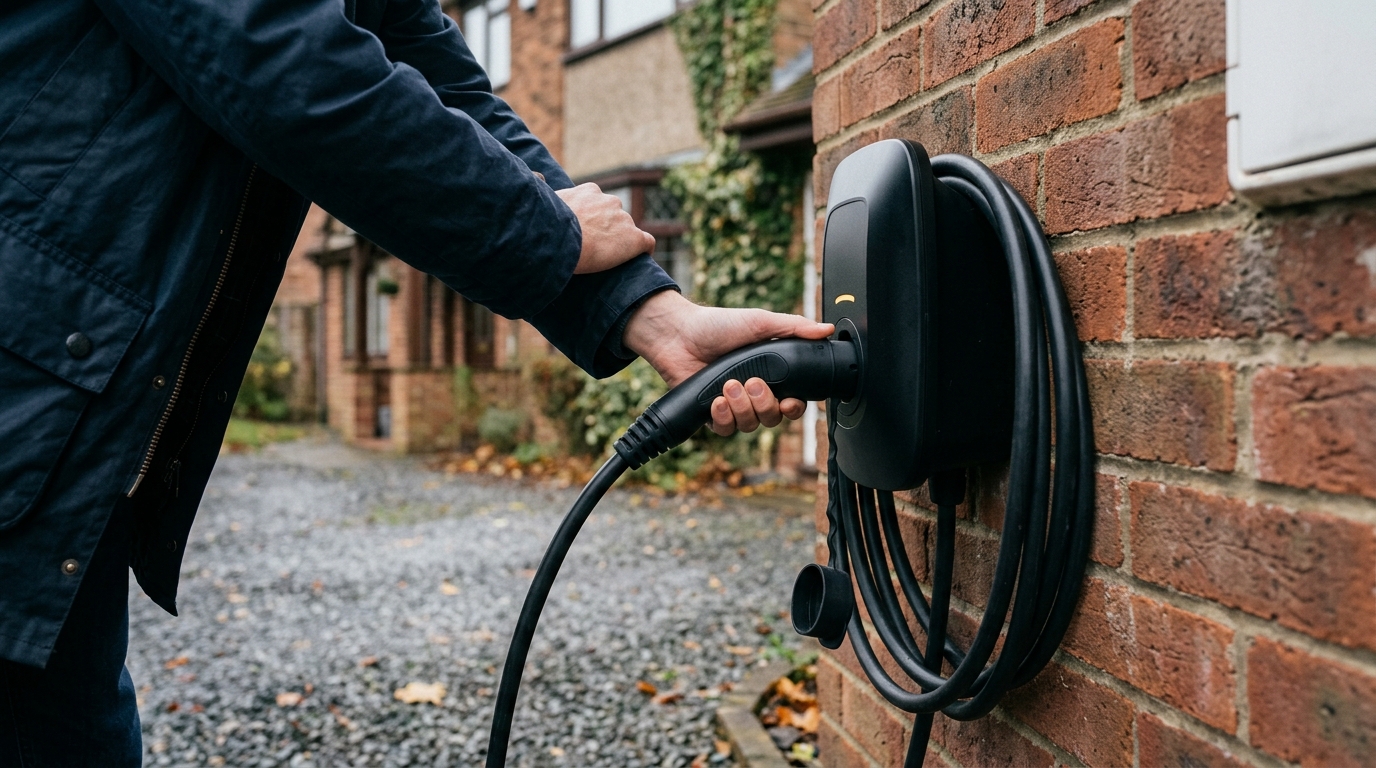
The cheapest charge in Britain is not on any network’s price board. It is your own driveway at 7p a kilowatt-hour, roughly a tenth of what a motorway rapid will charge you.
What this means for your running costs
Put it together and the running-cost picture for an EV is genuinely cheap, but only if you charge intelligently. The driver who does most miles at home on a smart tariff and uses Tesla open or a roaming app on the road will spend a fraction of what the petrol equivalent costs. The driver with no home charging who lives on PAYG rapids at 90p per kWh can end up paying close to petrol money per mile, which is the scenario that gives EVs an undeserved reputation for being expensive.
It is not the car, it is the charging strategy, and it is the same reason I tell buyers to price the whole ownership picture, from EV insurance costs to what EV drivers now pay in VED, before they sign anything. For company-car drivers the calculus is even more favourable once the tax is in, which is why a car like the new Mercedes GLC EV looks so strong on a scheme. But the charging side is the bit individuals control, and the spread between 7p at home and 92p on the dearest rapid is the widest lever you have over your monthly EV bill.
Where I’d plug in, and where I wouldn’t
My playbook is simple. Charge at home overnight on a smart EV tariff for everything you can, because at roughly 7p per kWh nothing else comes close. On a long run, seek out Tesla’s open Superchargers first at around 62p, and set up Octopus Electroverse or a network subscription so you are never paying the full walk-up PAYG rate. Treat InstaVolt and BP Pulse PAYG as the emergency option, not the habit, because at close to 90p per kWh they are the most expensive way to run an electric car short of a motorway services with no competition. None of this is complicated, but it is the difference between an EV that costs buttons to run and one that quietly drains your account. This is general guidance rather than a recommendation tied to your circumstances, so check the live tariff for your car and your area before you commit to a charger or a tariff.
Buyer action
EV and salary-sacrifice checks
Use this as the final check before paying a deposit, signing finance paperwork or relying on a headline monthly figure.