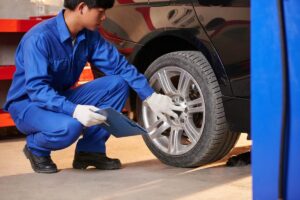
Here is the number that should make every EV driver check their tread depth this weekend: a set of tyres for an electric car now costs fleets 32% more than the rubber on an equivalent petrol or diesel, and they wear out sooner. That figure comes from Epyx fleet data published in August 2025, which put the average EV tyre replacement at £246 against £187 for an internal-combustion car. The premium isn’t a rounding error. It’s a structural cost of going electric that nobody puts on the showroom window sticker.
I’ve spent enough time staring at running-cost spreadsheets to know that the headline savings on an EV (cheaper home charging, lower servicing, no fuel duty) get quoted endlessly, while the line items that quietly claw some of that back get ignored. Tyres are the worst offender. So let’s put real numbers on it.
The mileage gap is bigger than most drivers expect
The clearest read on how much faster EV tyres disappear comes from Epyx fleet analysis, which found that EVs reach their first tyre change at 17,985 miles and 551 days old. The comparable petrol or diesel car gets to 24,335 miles and 670 days before the same job. That’s roughly 6,350 fewer miles and four months less life out of a set, a difference you feel as an earlier, repeated trip to the fitter rather than a one-off.
Stack that against the per-tyre price and the picture sharpens. The same Epyx data set pegged the average EV tyre at £207 and 18.59 inches, versus £130 and 17.40 inches for an ICE tyre. Bigger wheels, pricier rubber, replaced more often: it’s a three-way squeeze, and it all lands in the same year of ownership.
Why the rubber goes so quickly
None of this is a manufacturing fault or a dud batch. It’s physics. EVs are heavy: battery packs add several hundred kilos over a like-for-like combustion car, and that mass presses harder on the contact patch every mile. Emissions Analytics found that adding 450kg to a car’s weight increases tyre wear by 20%, which is exactly the order of magnitude that separates an EV from its petrol twin.
Then there’s the way an electric motor delivers its shove. Full torque from a standstill is the party trick that makes EVs feel quick off the line, but every one of those instant launches scrubs a little more tread away. Weight you can’t avoid; the right foot you can. The drivers I’d expect to see the steepest tyre bills are the ones enjoying the acceleration most.
The uncomfortable truth is that the two things you bought the EV for, the silent surge of torque and the planted feel of a heavy floor full of batteries, are the same two things quietly grinding your tyres into an early grave.
The industry has noticed, and fixing it properly costs more
The good news is that the tyre makers aren’t ignoring this. Michelin, Continental and Pirelli are all producing EV-specific tyres engineered to cope with the extra weight and torque while cutting wear and, in many cases, road noise: the latter matters more on an EV because there’s no engine din to mask it.
The catch is obvious: a purpose-built EV tyre sits at the premium end of the range, not the value end. So the move that extends tyre life is also the move that raises the upfront price. That’s the trade-off UK drivers actually face: pay more now for tyres designed for the job, or save at the till and replace sooner. For a car that already eats rubber faster, I think the maths favours the proper EV-rated tyre nearly every time.
What it actually costs per mile
Cost per mile is the only fair way to compare these, because the EV tyre’s shorter life is the whole point. Take the Epyx figures at face value. Four EV tyres at £207 each is £828 a set, and that set covers 17,985 miles: about 4.6p per mile in rubber. Four ICE tyres at £130 is £520, stretched over 24,335 miles: roughly 2.1p per mile. The EV driver is paying a touch over double per mile just to stay legal on tread.
Put a year’s driving against that and the gap stops being abstract. On a 10,000-mile year, the EV’s tyres work out at around £460 and the petrol car’s at about £214, a difference of nearly £250. That is close to the headline £246-versus-£187 single-replacement gap Epyx found, and it lands on top of, not instead of, the higher price of each individual tyre. If you cover serious mileage, or run a heavier performance EV on 20-inch wheels, scale it up accordingly: this is a floor, not a ceiling.
What this means for a private buyer, not just a fleet
Most of the hard data here comes from fleet operators, because they run enough cars to measure it cleanly. But the forces don’t care whose name is on the V5C. A heavy EV with instant torque wears tyres faster whether it’s a leasing-company saloon or your own car on the drive. The faster wear pattern shows up consistently across electric cars, so a private owner should budget for it from day one rather than being ambushed by the first replacement.
My rough planning figure: assume an EV will need its first set noticeably before 18,000 miles, and assume each tyre costs north of £200 fitted, more on a larger performance car. Build that into your whole-life cost before you sign anything. It won’t reverse the case for an EV, because the fuel and servicing savings are real, but it should temper the “electric is basically free to run” pitch.
How I’d take the sting out of it
Here’s where I land. If you’re already in an EV or about to be, do three things. Rotate the tyres on a strict schedule so the wear spreads evenly across all four rather than ruining the driven axle first. Keep them at the manufacturer’s pressures: under-inflation on a heavy car is a fast route to a shredded shoulder. And when replacement time comes, buy the EV-rated tyre, not the cheapest match the fitter has in stock; on a car this hard on rubber, the longer-life option usually wins on cost per mile even at the higher price.
What would change my mind on paying that premium? Genuinely cheaper EV-specific tyres reaching the mainstream, or a run of long-term data showing the new compounds close the wear gap rather than just narrow it. Until then, the honest position is this: an EV is still the cheaper car to run for most UK drivers, but only if you go in with your eyes open about the tyres, and price the first set in before the salesperson tells you how little it costs to charge.
Buyer action
EV and salary-sacrifice checks
Use this as the final check before paying a deposit, signing finance paperwork or relying on a headline monthly figure.