By June 2026, Mitie had put 6,000 electric vehicles on its UK fleet, 73% of the total, with the 6,000th unveiled by the UK Minister for the Future of Roads. Buried in that headline is a Volkswagen ID.Buzz story that started two years earlier: when WhatVan reported on 27 February 2024 that Mitie’s 4,000th electric vehicle was a Volkswagen ID.Buzz, it read like a neat round-number photo opportunity. Two years on, I think it was something more useful than that: an early read on whether the ID.Buzz is a genuine fleet tool or a lifestyle van wearing hi-vis. The facilities giant didn’t buy one for the press shot — that milestone vehicle was part of an order for 650 ID.Buzz vans, and the numbers since have all moved in one direction.
So with VW’s electric van-MPV now a fixture on UK order books, this is the moment to ask what those 2026 fleet figures actually tell a buyer — and where I’d still hold fire.
The Mitie order is the story, not the badge (VW ID.Buzz)
The detail that matters in the 2024 announcement isn’t the 4,000th-EV headline — it’s the commitment behind it. Mitie placed an order for 650 ID.Buzz vans to carry its cleaning, landscaping and engineering teams, with the milestone vehicle tied to a multi-million-pound contract with National Grid. At that point Mitie’s fleet was 60% electric, with a stated target of 100% electrification by 2025.
That’s a meaningful vote of confidence. A 650-unit order from a company that lives or dies by van uptime and total cost of ownership is a far stronger signal than any manufacturer range claim. Service fleets don’t tolerate vehicles that strand engineers mid-shift, and they don’t re-order at scale unless the maths holds. The ID.Buzz cleared that bar early.
From 60% to 73%: the 2026 read
The follow-through is what convinces me. By June 2026, as the trade press has tracked, Mitie had 6,000 EVs on its fleet — 73% electrified — with ID.Buzz vans among those deployed for engineering services through the likes of ESM Power. The 6,000th vehicle was unveiled by the UK Minister for the Future of Roads, which tells you how much political weight is now attached to fleet decarbonisation, but the operationally interesting figure is the climb from 60% to 73% in roughly two years.
That trajectory matters because it implies the early ID.Buzz vans didn’t quietly get parked up. A fleet operator that had been burned by range, charging hassle or downtime would have slowed its electrification curve, not accelerated it. Mitie kept buying. For anyone weighing an electric van order in 2026, that is the closest thing to an independent, real-world reference you’ll get without running your own pilot.
What £35,960 actually buys
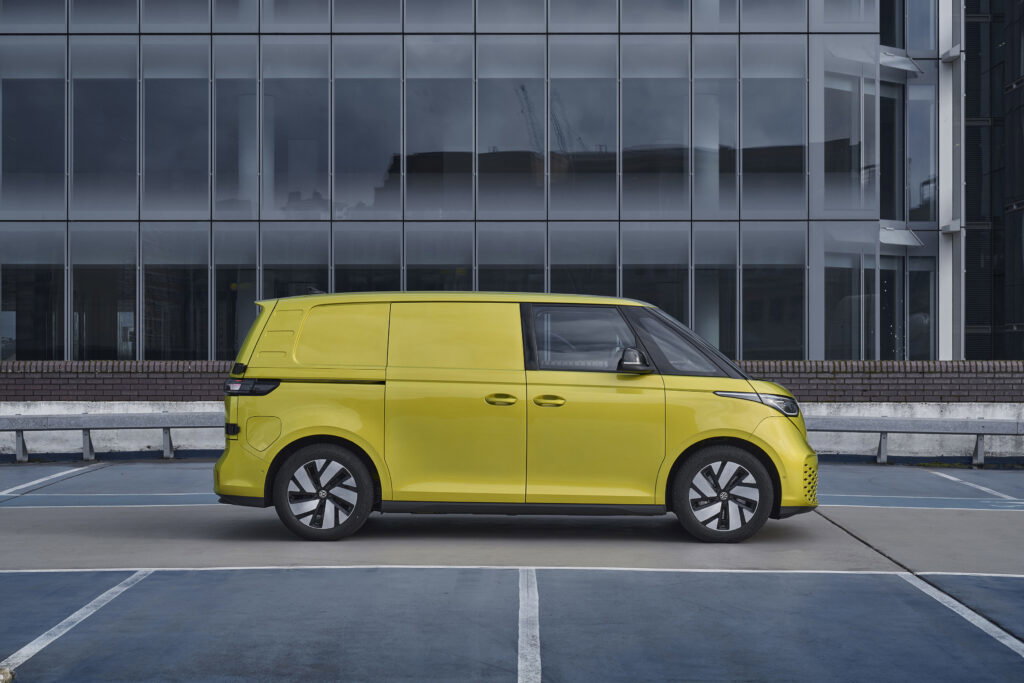
For buyers who want the working van rather than the seven-seat people-carrier, the relevant variant arrived in March 2025. As NE Connected detailed, the ID.Buzz Cargo Commerce 59kWh joined the range from £35,960 OTR including VAT, with a 200-mile WLTP range, 3.9m³ of load space, a 692kg payload and 165kW rapid charging.
Those are honest numbers rather than flattering ones, and I’d rather have them that way. A 200-mile WLTP range realistically lands lower once you load the van, run the heater through a January morning and sit in traffic — so this is a vehicle built for predictable urban and regional duty cycles, not motorway-heavy long-haul. The 165kW rapid charging is the saving grace: top-ups at a depot or en route keep a multi-drop day moving. The 3.9m³ load volume is modest, so if your work is bulky pallet freight, this isn’t your van. If it’s tools, parts and people doing service calls — exactly Mitie’s use case — it fits.
Where I land on it
I’m genuinely positive on the ID.Buzz as a fleet vehicle, and I don’t say that often about a van that asks £35,960 before you’ve added a single option. The reason is the evidence trail: a 650-unit order in 2024 that didn’t get quietly unwound, followed by a fleet that pushed on to 73% electric by 2026. That isn’t marketing — it’s a hard-nosed facilities operator voting with its capital budget twice.
The buyer I’d point at it is a mid-size service or facilities fleet running predictable urban and regional routes from a depot with charging — landscapers, engineers, mobile maintenance, the kind of work where a van returns to base most nights. For that operator, the ID.Buzz now has a track record behind it, not just a brochure. The trade press has watched these vans go into hard daily service and stay there.
The buyer I’d steer away is anyone running high-mileage trunk routes or relying on full payload and bulk capacity. A 200-mile WLTP figure and 3.9m³ of space will frustrate you, and a diesel Transporter still wins that brief on range and load.
What I’d need to see before I signed off a fleet of these
If I were placing the order, the Mitie numbers would get me to the table — but I’d want my own one-month pilot on my actual routes before committing real budget: watching real-world range against that 200-mile claim with vans loaded and heated, and stress-testing depot charging capacity at shift change. Get those two answers right and, on this evidence, I think the ID.Buzz earns its place. Get them wrong and no amount of someone else’s 6,000-EV headline will save your uptime. The evidence says it works; just make sure it works for your day.
Buyer action
Where to check next
Use this as the final check before paying a deposit, signing finance paperwork or relying on a headline monthly figure.